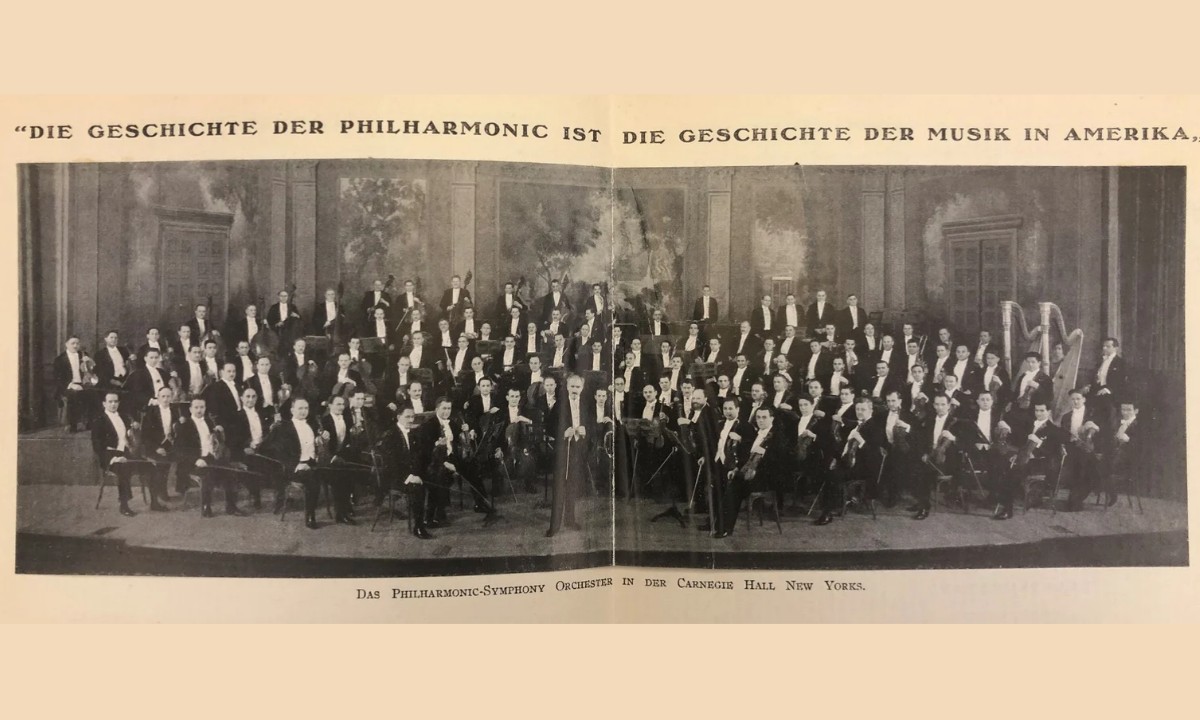
Full New York Philharmonic under Arturo Toscanini. This photo was used in publicity material for the Orchestra's European tour concert programs, 1930.
Steffy Goldner's life and career between Vienna and New York
Steffy (Stephanie) Goldner was the first female member of the New York Philharmonic. The young Viennese Jewish woman was already successful as a harpist in her hometown. When she was offered a position in the New York Philharmonic at the age of 26, she was also one of the youngest. The artist Nives Widauer has dedicated a multimedia installation to this extraordinary life, in collaboration with the New York Philharmonic Archives. The installation can be seen in the Project Space of the Jewish Museum Vienna from October 20, 2026 to March 22, 2027.
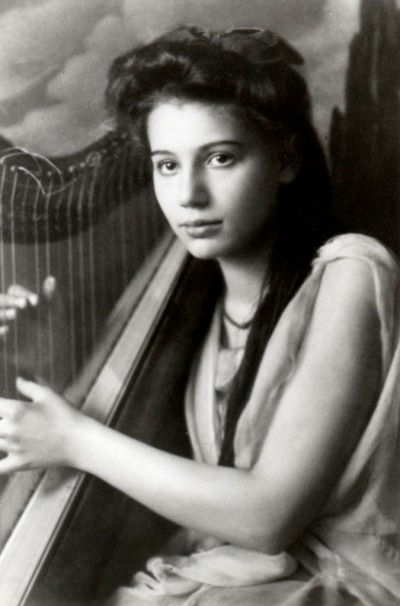
© New York Philharmonic Archives, courtesy of Doris Balant
Steffy Goldner at the Vienna Academy of Music
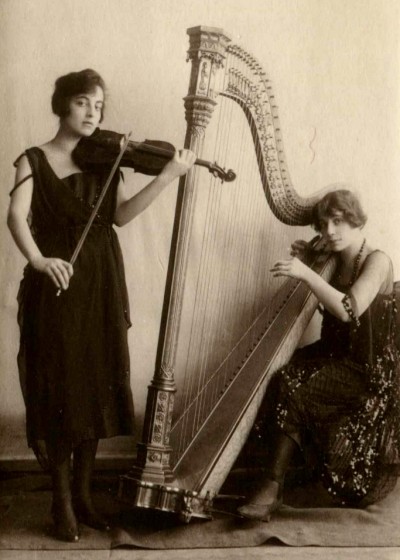
© New York Philharmonic Archives, courtesy of Doris Balant
1918 concert promotion photo of Gertrude (left) and Steffy (right) with their respective instruments
Steffy Goldner (1896–1962), was born in Vienna to a sophisticated Jewish family and, like her siblings, became a musician. She began taking harp lessons at the age of eight, beginning her studies with Vicky Baum, who had been a harpist before embarking on her writing career. At the age of 9, Goldner was admitted as a student at the University of Music and Performing Arts. Her teacher there was Therese Zamara, who was one of the first female faculty and the first of an orchestral instrument. Zamara, however, was only allowed to teach preliminary education and not professional training. In order to advance her studies, Goldner took lessons with Zamara’s brother.
By the age of 16 Goldner was performing chamber music with her sisters, touring with professional orchestras in Germany and England, and gaining reputation as a conductor’s favorite while also receiving repeated praise from the press. Of note, the Allgemeine Sport-Zeitung reported on her performance at the Apollotheater in May 1916: "The harpist Stephanie Goldner not only masters this instrument technically to the most perfect degree, but also reveals, especially in a fantasy on Schubert songs, its wonderful wealth of soul; it is the most mature – purest art – and perhaps the strongest success of this variety program." Historical press reports also reveal the diversity of her engagements: in addition to numerous classical concerts, she played at the Hanukkah celebration of the Zionistischer Zentralverein in December 1918, which took place at the Musikverein, and in 1919 she took part in a fairy tale evening for Jewish children, at which works by Shalom Asch and Martin Buber, among others, were performed. Oskar Nedbal, who served as chief conductor of the Vienna Tonkünstler Orchestra - which was founded by him - from 1906 to 1919, wrote outstanding letters of recommendation for her to the Vienna Philharmonic - but, unfortunately, to no avail. It stands to reason that the decision not to hire Goldner was motivated by misogyny. It wasn't until 80 years later that the orchestra welcomed its first female member: Harpist Anna Lelkes was offered a permanent position with the ensemble as late as 1997.
Although Goldner was in great demand as a harpist in Europe – even without the Vienna Philharmonic – her income was not considerable. Her father was seriously ill and the family was dependent on additional income. That and a difficult climate in Vienna after World War I led her to make the 10-week journey to New York City on the Oropesa from Cherbourg. She joined the Capitol Theatre Orchestra, a Broadway movie palace ensemble. In this case, too, she was the first female member of the ensemble. It was in this orchestra that she would meet her future husband, the conductor Eugene Ormandy, and marry him as early as 1922. Like Goldner’s parents, Ormandy was from Hungary, and the couple shared not only a passion for music but also common roots in the former Habsburg Empire.
That same year she entered the New York Philharmonic as its first woman member. In her ten years with the Philharmonic, Goldner toured widely across the United States, traveling by train. In 1930, Arturo Toscanini took the Orchestra to Europe; Goldner and her male colleagues appearing on the most important stages of the cultural capitals, including Vienna. Her traveling harp case came with her, serving as a dressing room where halls did not provide changing areas for women.
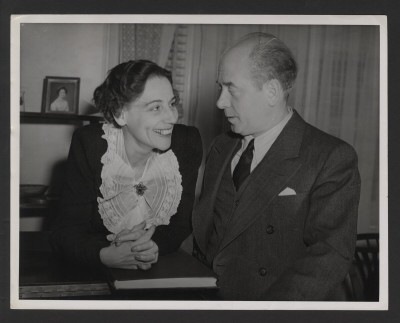
© Eugene Ormandy Photographs, 1880-1992, Ms. Coll. 330, Kislak Center for Special Collections, Rare Books and Manuscripts, University of Pennsylvania
Steffy Goldner and her husband Eugene Ormandy in 1940
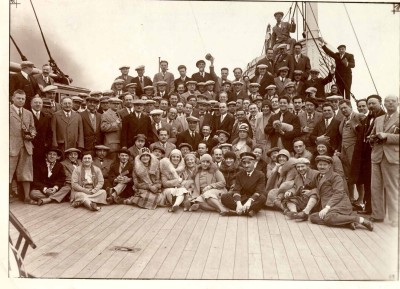
© Image ID: 800-139-04-009, New York Philharmonic Shelby White & Leon Levy Digital Archives
New York Philharmonic musicians, wives (seated), and crew aboard the SS De Grasse, 1930. Goldner, the only woman standing, is at center-right, next to the man holding a dog.
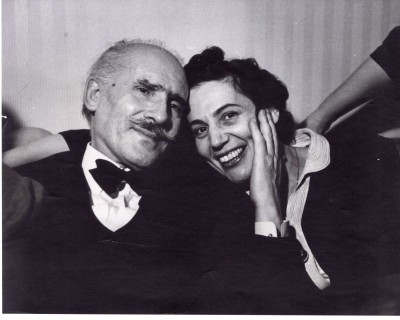
© Eugene Ormandy Photographs, 1880-1992, Ms. Coll. 330, Kislak Center for Special Collections, Rare Books and Manuscripts, University of Pennsylvania
Arturo Toscanini & Steffy Goldner in Philadelphia, 1943. Photo: Adrian Siegel
Goldner retired from performing in 1932 to support Ormandy’s career when he became Music Director in Minneapolis, and in 1938, Philadelphia. The New York Philharmonic remained without a female member for the next 34 years. Although Goldner was giving lessons at the Philadelphia Academy of Music from time to time, she no longer played as a soloist and took on the role of housewife and manager of her husband.
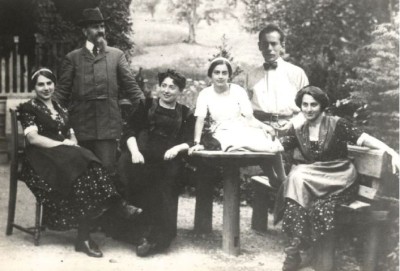
© New York Philharmonic Archives
Steffy Goldner with her family during a visit at Vienna
During the 1930s the couple frequently visited Goldner’s family in Austria, extended summer vacations where the couple’s wine-colored Cadillac was shipped by boat so the family could drive through the Alps. Before the Anschluss, great effort was made to relocate the extended family to a safe house in Strobl, before bringing them to the United States.
There, the families lived together for many years in an estate with several domestic servants. Steffy Goldner became the host for receptions of the Philadelphia Orchestra.
Stephanie Goldner, harp, and her husband Eugene Ormandy, violin, playing Souvenir by František Drdla, selections appearing on the record "The Art of Eugene Ormandy," courtesy of Biddulph Recordings Ltd.
The Ormandys had a difficult relationship, strained by the death of two children in infancy. They divorced in 1947, and five years later Steffy Goldner returned to New York, where she resumed playing sporadically. But she did not succeed in re-entering a professional career. In 1962, she died of a misdiagnosed pancreatic cancer.
Nives Widauer, born in Basel, now lives in Vienna and has been working in the fields of installation art, video, painting and sculpture since the 1980s. Widauer's installation on Steffy Goldner projects images and film excerpts from the harpist’s life onto the historic harp case. It focuses on the extraordinary career of a young Viennese Jewish woman in New York, which unfortunately ended with an all-too-typical female fate. The installation takes this story as an opportunity to draw attention to the inequalities that women face in the art sector, then and now.
For further information, photos, audio, and video recordings of Steffy Goldner, please visit the New York Philharmonic's online exhibition: Steffy Goldner, The New York Philharmonic’s first Woman: https://exhibits.nyphil.org/goldner/
This summary of her life has been culled from original materials, including from the New York Philharmonic Archives: memorabilia from the New York Philharmonic's 1930 Europe tour, press clippings, personnel records, and printed programs. Also invaluable were correspondence, programs, and an oral history available in a collection donated to the Philharmonic by Doris Balant, Stephanie Goldner's niece. Additional sources consist of The Eugene Ormandy Papers, Hermann Goldner, and Stephanie Goldner Collections at the University of Pennsylvania, as well as the Rodgers and Hammerstein Archives of Recorded Sound at the New York Public Library for the Performing Arts.
The New York Philharmonic Archives houses the historical scores, recordings, programs, and business documents of the New York Philharmonic, the oldest orchestra in the United States, founded in 1842. Goldner’s harp case was found in North Carolina and acquired in 2014. archives.nyphil.org
We extend our thanks to Severin Matiasovits of the Archives of the University of Music and Performing Arts for information regarding Goldner’s years at the University of Music and Performing Arts.
We extend our thanks to Irma Wulz of the Archives of the Jewish Community of Vienna for information regarding Goldner’s biographical details and family.